Restoration and conservation of Notre-Dame de Paris : les will Viollet-le-Duc’s stained glass windows soon be replaced ?
The Grand Palais is presenting, until March 2026, the models for six contemporary stained glass windows designed for Notre-Dame by the artist Claire Tabouret. They are intended to replace six stained glass windows designed by Eugène Viollet-le-Duc. Although these stained glass windows were not damaged by the 2019 fire, the project is giving rise to strong controversy. A recent decision of the Paris Administrative Court allows a review of the legal framework of this public procurement contract (Paris Administrative Court, 27 November 2025, no. 2502474/3-3).
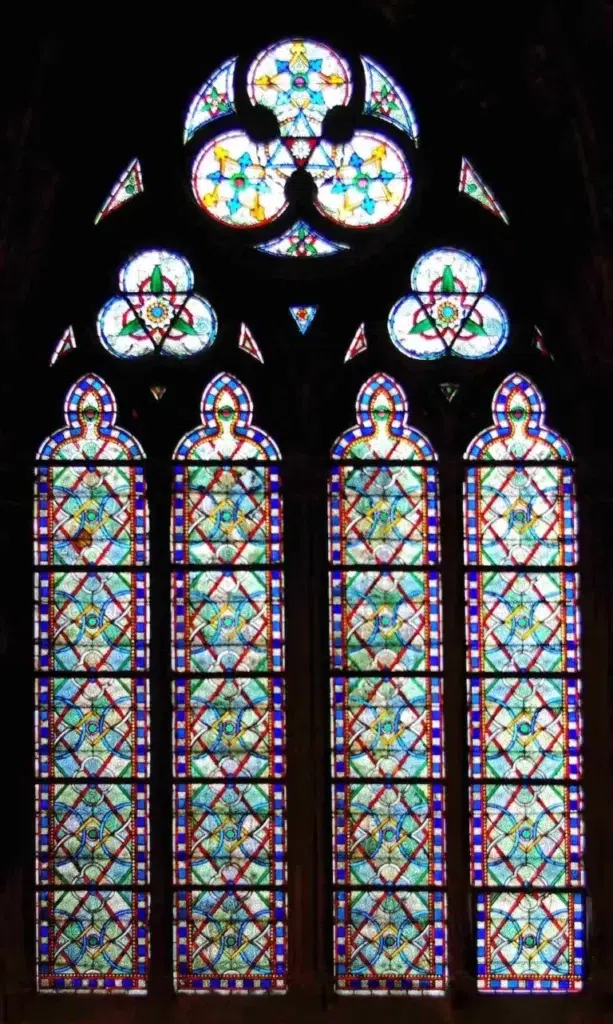
Janericloebe (Domaine public) – https://www.faton.fr/vitraux-viollet-le-duc-notre-dame/
AN OLD HERITAGE CONTROVERSY BETWEEN CONSERVATION AND CREATION
The idea of replacing the stained glass windows of Notre-Dame by Viollet-le-Duc with contemporary stained glass windows is not new. In 1935, twelve master glassmakers submitted projects to the Commission for Historical Monuments to replace certain of the architect’s stained glass windows. Already at that time, supporters of the renewal of art in churches were confronted with the opposition of defenders of heritage conservation, concerned with preserving the integrity of the monument. The same occurred when the idea of a contemporary spire was raised in 2019.
The current controversy over the stained glass windows is part of this continuity. In essence, supporters of the project for new stained glass windows wish to bring a contemporary touch to the building, and emphasise that Viollet-le-Duc himself profoundly transformed the cathedral in the 19th century, not hesitating to remove or modify medieval elements. They also cite numerous precedents of listed monuments in which contemporary works have been integrated (the Buren columns, Pierre Soulages’ stained glass windows in the abbey church of Conques, etc.).
Conversely, opponents of the project argue that there is no reason to replace these 19th-century stained glass windows, the objective of the restoration of the cathedral being to return, as far as possible, to the last known visual state before the disaster.
In July 2024, the National Commission for Heritage and Architecture moreover unanimously ruled against the removal of the stained glass windows, notably due to their good state of conservation and the fact that the “Viollet-le-Duc” state had served as a reference for all decisions relating to the restoration works.
THE BOUNDARIES OF THE NOTIONS OF “CONSERVATION” AND “RESTORATION”
In this context, the Administrative Court was seized of the legality of the public contract concluded by the ad hoc public institution, created by the law of 29 July 2019 with the name and mission “to ensure the conduct, coordination and implementation of studies and operations contributing to the conservation and restoration of the Notre-Dame de Paris cathedral” (art. 9). The same law instituted a national subscription, which made it possible to raise more than 800 million euros for the restoration of the building.
In the present case, the disputed contract concluded with the artist Claire Tabouret and the workshop of master glassmakers Simon Marcq concerns “the design, production and installation of contemporary stained glass windows in the bays of six chapels in the south aisle of the nave of Notre-Dame de Paris cathedral”.
An association and a donor argue that this public contract would be “unlawful”, insofar as the commissioning of contemporary stained glass windows would constitute neither an act of conservation nor an act of restoration, and would thus exceed the powers of the public institution. On 27 November 2025, the Paris Administrative Court dismissed the application.
The court held that the terms “conservation” and “restoration” are not defined either in the 2019 bill or in the Heritage Code, for buildings listed as historic monuments. The judge was invited by the applicants to refer to the definitions of these two terms in the 1964 international charter on the conservation and restoration of monuments and sites, known as the “Venice Charter”, signed by France.
Regarding conservation, the charter provides in particular that the “relocation of all or part of a monument may only be tolerated where the safeguarding of the monument so requires or where reasons of major national or international interest justify it” and “the elements of sculpture, painting or decoration forming an integral part of the monument may only be removed when this measure is the only one capable of ensuring their conservation”.
Regarding restoration, the charter emphasises that it must remain exceptional in character and “be based on respect for the ancient substance and authentic documents”. However, the judge recalls that the charter has no binding force in domestic law; this text thus sets out guidelines, which the judge is free to take into account, but is not obliged to apply.
Finally, the judge relativises the scope of the unfavourable opinion of the National Commission for Heritage and Architecture, due to its purely consultative nature. The public purchaser is therefore not bound to comply with it.
In doing so, the court validates a broad interpretation of the notions of “conservation” and “restoration”, allowing the public institution to include contemporary artistic choices therein. Incidentally, it should be noted that, even though Article 13 of the Charter is not mentioned in the decision, it appears compatible with the introduction of contemporary stained glass windows in the cathedral: “Additions may only be tolerated insofar as they respect all the interesting parts of the building, its traditional setting, the balance of its composition and its relations with the surrounding environment”. The association has announced that it will appeal the judgment.
In parallel, the continuation of the project will soon require the removal of Viollet-le-Duc’s stained glass windows. Given the cathedral’s classification as a historic monument in 1862, this operation is subject to obtaining authorisation from the administrative authority, which may also be subject to an administrative appeal¹.
This article was published in the journal “L’Objet d’art”.

Attorney & Partner
odebaecque@debaecque-avocats.com
Tél. + 33 (0) 1 53 29 90 00